Real Facts About the DTF-Modified Epson L805 and L1800: Is This Business for You?
Published 3 September 2021
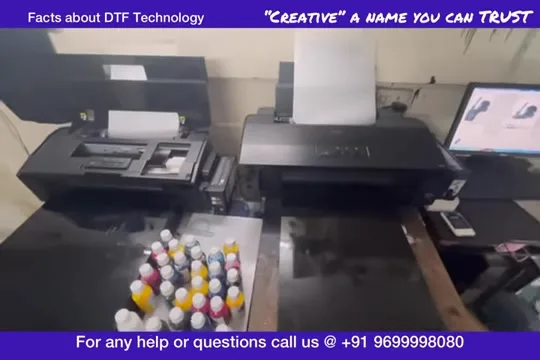
By September 2021 the questions were arriving faster than I could answer them one by one, so I made this ten-minute clarity video: is the DTF business for you, and if it is, L805 or L1800? It is Hindi, filmed in the workshop with both printers running and a tableful of ink bottles. The printers are gone from the market now, replaced by the L8050 and L18050, but every warning in it still applies to converted printers today. Here it is in English.
What the video shows
- 0:00 — Why this video: is this business for you?
- 0:17 — Two printers in the market: L805 (roll-fed) and L1800 (sheet or roll)
- 0:52 — What a modified printer is, and what it is not
- 1:10 — Nobody gives a head warranty on a modified printer, from any dealer
- 1:25 — Parts loosen with use; my printers still work, head never changed
- 1:41 — Feeding issues happen on both; do not expect a problem-free printer
- 1:58 — Do not remove belts or improvise; the sheet drops and damages the head
- 2:33 — The wooden exit bed, measured to the head distance
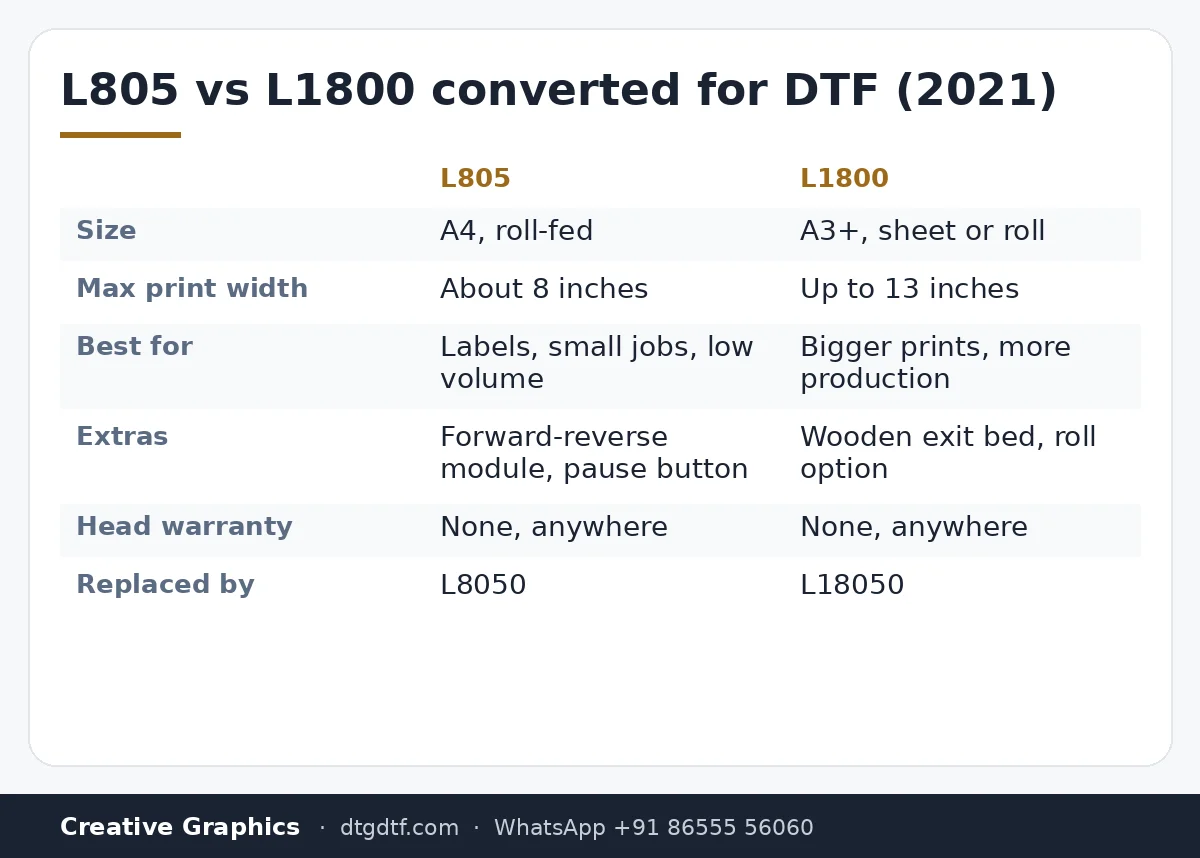
- 2:51 — L805: 8-inch max width, label work, small jobs
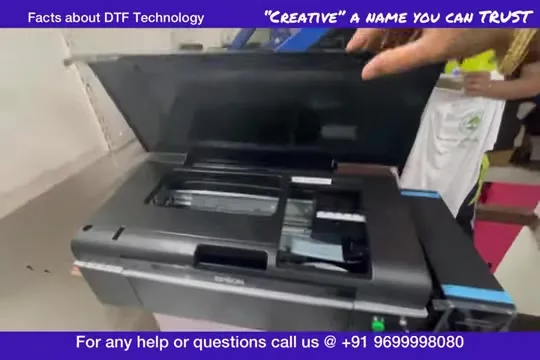
- 3:11 — Forward-reverse module and the pause button
- 3:26 — L1800 for bigger prints and more production
- 4:06 — 'Jugaad technology': don't expect miracles from anyone
- 4:40 — Ink quality
Two printers, two jobs
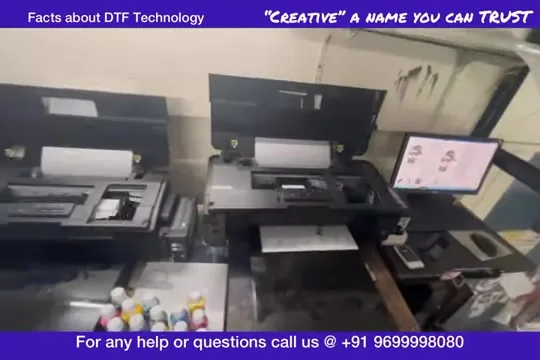
In 2021 we sold two converted Epsons. The L805, A4, which we built as a roll-fed model, and the L1800, A3+, available sheet-fed or roll-fed. The video starts by clearing up what "modified" means: the head assembly, ink path and feed are changed so the printer can run DTF ink and film; it does not become an industrial machine.
The head warranty question
Said plainly on camera: no one, no dealer, nowhere, will give you a warranty on the head of a modified printer. Not us either. Parts loosen with use; that is the nature of a desktop printer doing a job it was not built for. For balance I pointed at my own printers, still running after a lot of prints, head never changed. Both things are true at once.
Feeding issues are normal; improvising is not
Both printers can misfeed. Expect it, learn to load film properly, and sometimes a print will have to be redone. What you must not do is start pulling belts and rollers to "fix" feeding on your own. Once the belt is out, the sheet drops as it exits, and a dropped sheet under a moving head damages the head. If you insist on doing things yourself, fine, but know that the head is at risk and it is yours to take care of.
The wooden exit bed
Our fix for the dropping sheet was a wooden bed at the exit, built to a measured distance from the head so the sheet stays level as it comes out. Crude-looking, effective, and the ancestor of the delivery trays we fit now.
Which one for you
- L805: maximum width about 8 inches. Labels, small jobs, low volume. It ships with a forward-reverse module and a pause button so you can stop mid-print.
- L1800: up to 13 inches wide, for bigger prints and more production.
Either way you have to learn how to feed it. People asked for a printer with no feeding issues at all; on a converted desktop printer that does not exist.
"Jugaad technology"
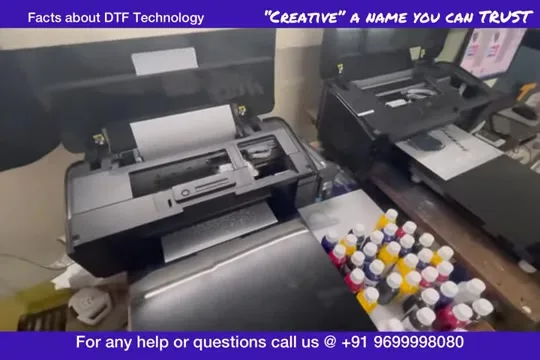
That is what I called it in 2021 and I stand by it: converted printers are improvised engineering. Do not expect a miracle from anyone, whoever is selling. What you can expect is honest advice on ink: use good ink and the head lasts; use cheap ink and the warranty question answers itself.
What replaced these printers
The L805 and L1800 were discontinued and the L8050 and L18050 took their place. Everything above carried over, and the conversion got better: see the L18050 and L8050 honest review and the modifications and maintenance walkthrough. Today's converted printer is the L18050 DTF Printer at ₹92,300 + GST, sold without warranty and tested before dispatch. If you want a warranty, buy a dedicated DTF printer; the mainboard is covered for a year.
Frequently asked questions
Is there a head warranty on a modified L805 or L1800?
No, from anyone. The head on a converted printer is not covered; ink quality and care decide its life.
L805 or L1800?
L805 for labels and small jobs up to about 8 inches wide. L1800 for bigger prints and more volume, up to 13 inches.
Why do sheets drop and scratch?
The exit rollers are removed on a converted printer. Without a level exit bed the sheet drops under the head. Do not remove belts to fix feeding.
Are these printers still sold?
No. The L805 and L1800 were replaced by the L8050 and L18050, which we convert the same way with better modules.
What did you mean by jugaad technology?
That a converted desktop printer is improvised engineering. It works, but expect feeding issues and maintenance, and never expect a miracle from any seller.
Related guides
- DTF Printer Buying Guide — What to Look For (and Avoid) in India
- Starting a DTF Printing Business in India — Real Cost Breakdown
- Why Do DTF Prints Peel After Washing? Real Fixes
Thinking about a converted printer?
Tell me your job size and daily volume on WhatsApp. I will say whether converted or dedicated makes sense for you.
WhatsApp +91 86555 56060More videos: Epson L18050 / L8050 DTF conversion
- Epson L18050 and L8050 Converted to DTF: The Honest, Uncut Review
- Epson L18050 DTF Without Tape: PE/PW Bypass Module, Dampers, Capping and a Live Print
- L18050 Roll Conversion Kit: ASF and PE/PW Bypassed, Forward-Reverse Film Control
- Epson L18050 DTF Conversion, Step by Step: The Complete 38-Minute DIY Guide
- Our Converted L18050 DTF Printer: What We Modify, How You Maintain It, and Who Should Buy It
- Epson L18050 DTF Maintenance: Manual Head Cleaning, Taping Sheets Properly, Roll Feeding and Ink Charge