How to Start a DTF Business: L805, L1800 or a 12 / 24-Inch Industrial? The 2021 FAQ, Answered Again
Published 6 December 2021
By the end of 2021 the same questions were arriving every day from people who wanted to start a DTF business: which printer, how much maintenance, which fabrics, press or oven, sheet or roll. So I answered them in one video from the exhibition stall, with the printers and the tees on the table. The audio on this upload is rough, so I am writing from what I said and what is on screen. The questions have not changed; a couple of answers have, and I say where.
What the video shows
- 0:00 — The questions new business owners ask
- 0:48 — Three options: L805, L1800, 12 or 24-inch industrial
- 1:49 — L805 (A4) vs L1800 (A3): what each can print
- 2:49 — Industrial printers cost more; do not start big
- 3:34 — One big printer stops, production stops; two small ones do not
- 4:29 — Maintenance: a head clean is two or three presses
- 5:13 — Six days of demo in Kanpur without a problem
- 5:33 — Consumable quality: low versus good film side by side
- 6:27 — Fabrics: cotton best, polyester lighter, georgette diffuses
- 7:57 — Curing: heat press versus oven
- 8:53 — Roll versus sheet: non-stop, about 30% faster
- 10:27 — Forward-reverse module needs only a power supply
Three options
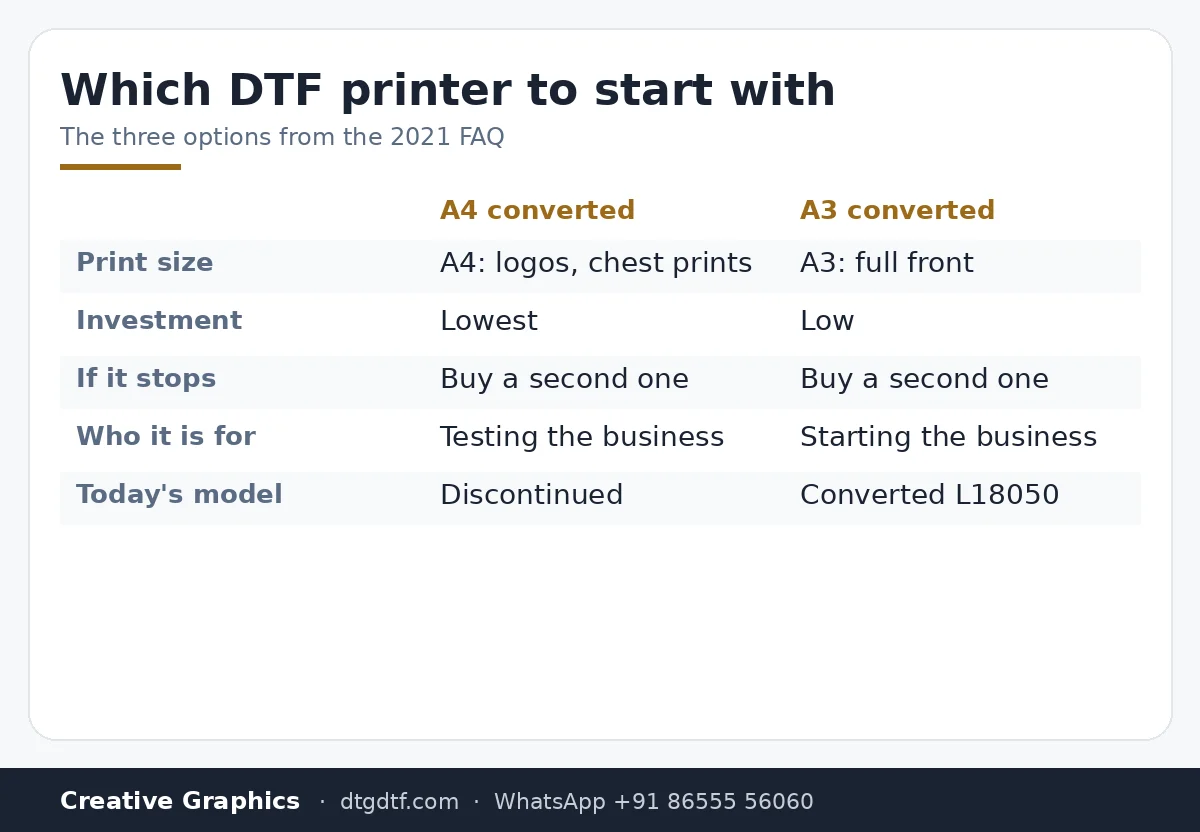
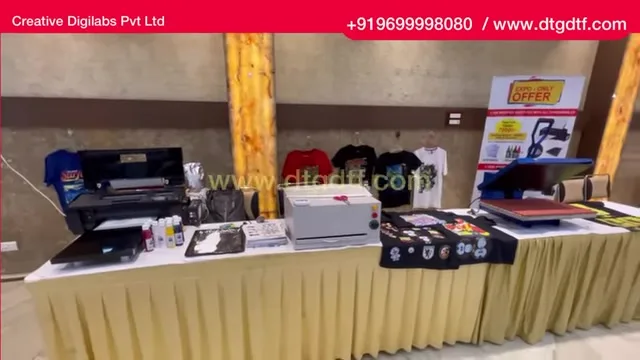
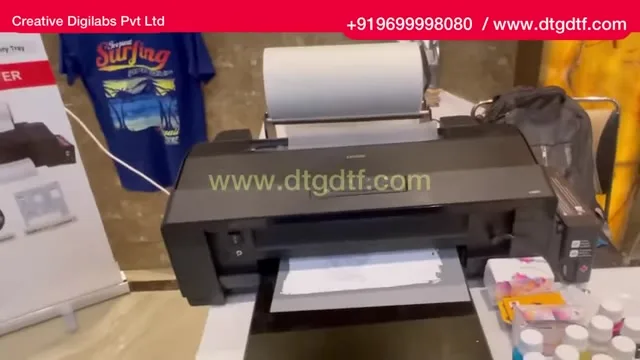
Converted Epson L805, A4 size, the cheapest entry; converted Epson L1800, A3, the one on the stall; and 12 or 24-inch industrial machines with XP600 or i3200 heads. The L805 handles small logos and chest prints; the L1800 gives you a full A3 front print. Everything else about them is nearly the same.
Do not start big
Industrial printers cost many times more, and my advice to a startup was and is: do not. If your one big printer has a maintenance issue, production stops. Two or three small printers at the same money keep you running; one goes down, the other two work until it is fixed. Buy the big one when the orders justify it.
Maintenance, honestly
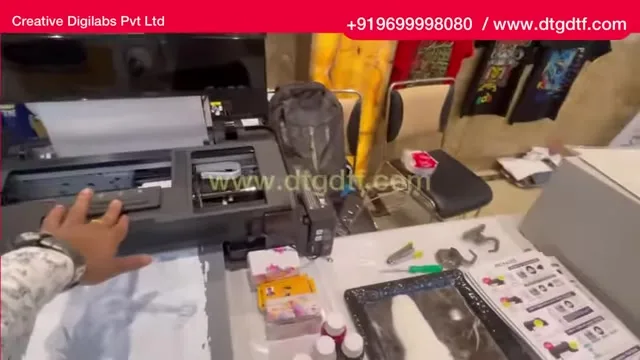
Whichever printer you buy, maintenance exists. Small or big. With good consumables it is small: a head clean is pressing the button two or three times. I carried this demo printer from Mumbai to Kanpur and ran it six days at a show with nothing more than that. Tissue-and-syringe cleaning only becomes necessary when a printer sits unused for ten or fifteen days.
Consumables decide the output
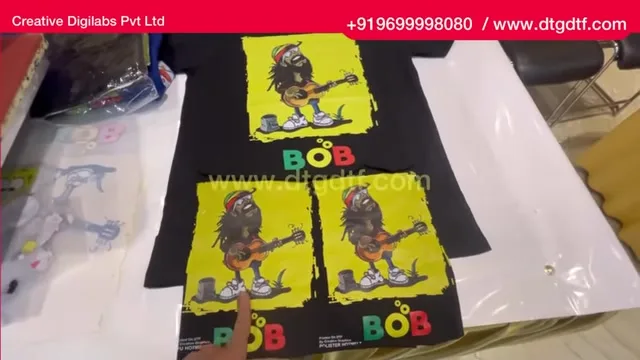
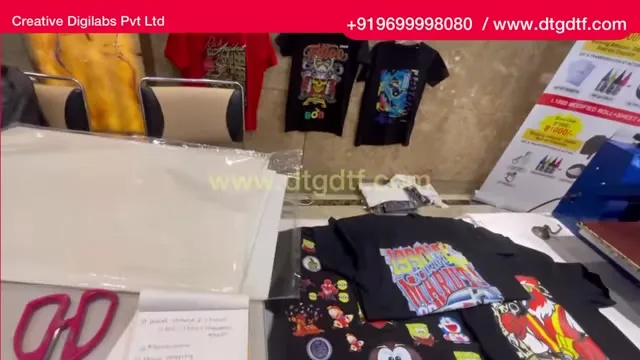
I held up two transfers, one on cheap film and one on good film, printed on the same machine. The difference is visible from a metre away. Whatever your printer costs, low-quality film, powder or ink gives low-quality output and extra maintenance. Use good consumables; it is the cheapest thing you will ever do for the business.
Fabrics
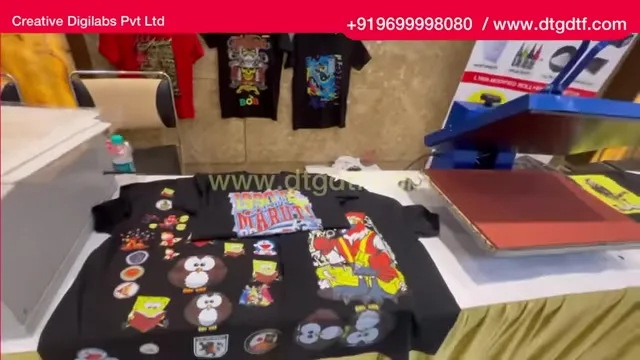
DTF was made for cotton; that is where you get the best result. Polyester works, slightly lighter. Georgette and loose weaves diffuse the ink into the fabric, so the print looks faint. If you are starting a printing business, cotton tees are where the volume is anyway.
Press or oven for curing
You can cure with a heat press: take it to around 190 degrees, hover-cure the powder, drop the temperature, then press. It works, it takes time and burns more electricity. An oven cures at the right temperature while the press stays at pressing temperature, so the two never fight each other. For a one-person setup the press alone is fine to begin; add the oven when orders come.
Roll or sheet
Roll printing runs non-stop: you queue jobs while the printer prints and expect about 30 percent more working speed. In 2021 that meant a forward-reverse module, which only needs a power supply to work, plus our roll software. Today it means ZiggRoll V4 on a converted L18050 or L8050, no module needed. What I would change from the 2021 answer: the L1800 and L805 are discontinued, so the small printer today is the converted L18050 at ₹92,300 + GST, and the step up is the X-Arc 600 Pro. The step-by-step business plan is in the starting guide.
Frequently asked questions
Which printer should I start a DTF business with?
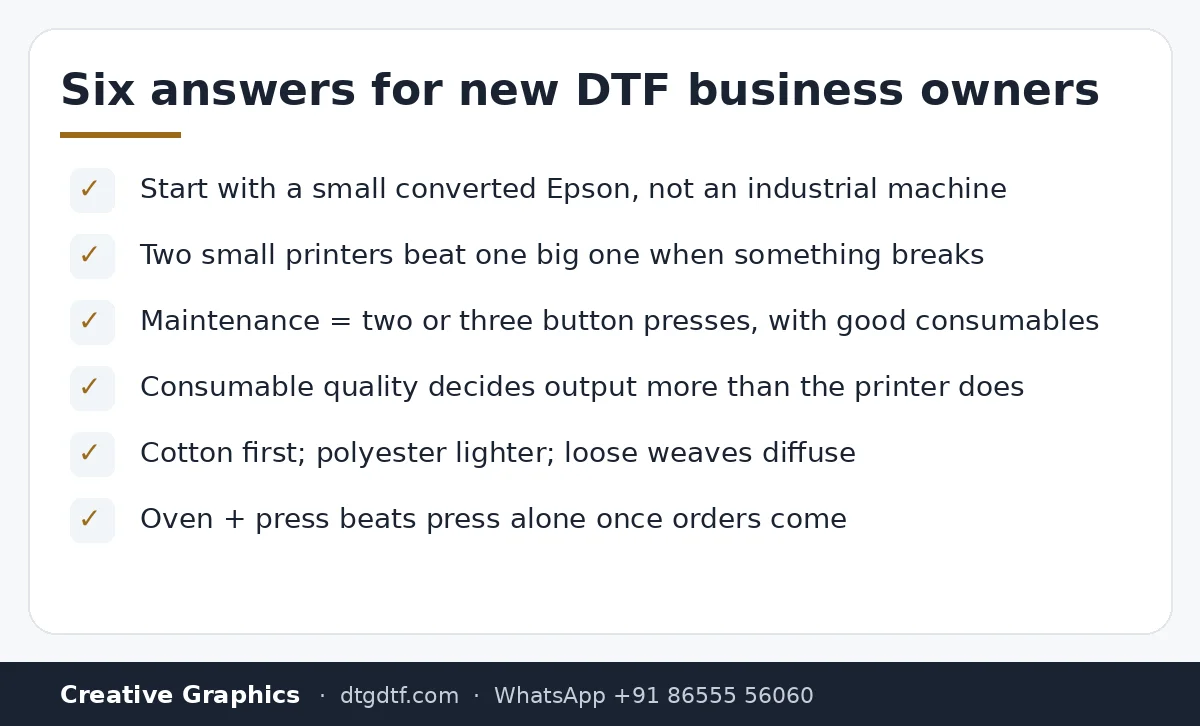
A small converted Epson. In 2021 that was the L805 (A4) or L1800 (A3); today it is the converted L18050. Industrial machines come later.
Is one big printer better than two small ones?
Not at the start. If the big one stops, production stops. Two small printers keep you running.
How much maintenance does a DTF printer need?
With good consumables, a head clean of two or three button presses. Manual cleaning only after the printer sits idle for ten or fifteen days.
Which fabrics does DTF work on?
Cotton best; polyester slightly lighter; loose weaves like georgette diffuse the ink.
Heat press or oven for curing?
A press alone works but is slower and uses more electricity. An oven cures while the press stays at pressing temperature.
Is roll printing worth it for a beginner?
It is about 30 percent faster and runs unattended. Start on sheets if your volume is low, move to roll with ZiggRoll when orders grow.
Related guides
- Starting a DTF Printing Business in India — Real Cost Breakdown
- DTF Printer Buying Guide — What to Look For (and Avoid) in India
- DTF Printing Cost Per Meter — Real Numbers from a Print Shop
- What is DTF Printing? Direct-to-Film Explained Simply
Starting out?
Tell me your budget and daily volume on WhatsApp and I will tell you which printer, honestly.
WhatsApp +91 86555 56060